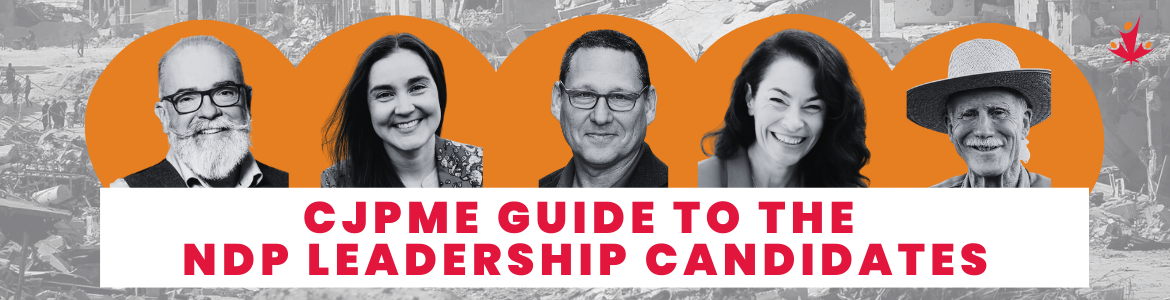
Canadians for Justice and Peace in the Middle East (CJPME) has assessed each of the candidates in the 2026 leadership race for the New Democratic Party (NDP) in terms of their commitment to a Canadian foreign policy that upholds Palestinian human rights.
Click here to download the full report in PDF format, or read the executive summary below.
Executive Summary
Canadians for Justice and Peace in the Middle East (CJPME) has prepared the following assessment of New Democratic Party (NDP) leadership candidates on the issue of Palestinian human rights. While not intended to be an extensive guide, the following assessment considers the statements and record of each candidate to assist NDP members in choosing a leader who reflects their priorities on human rights.
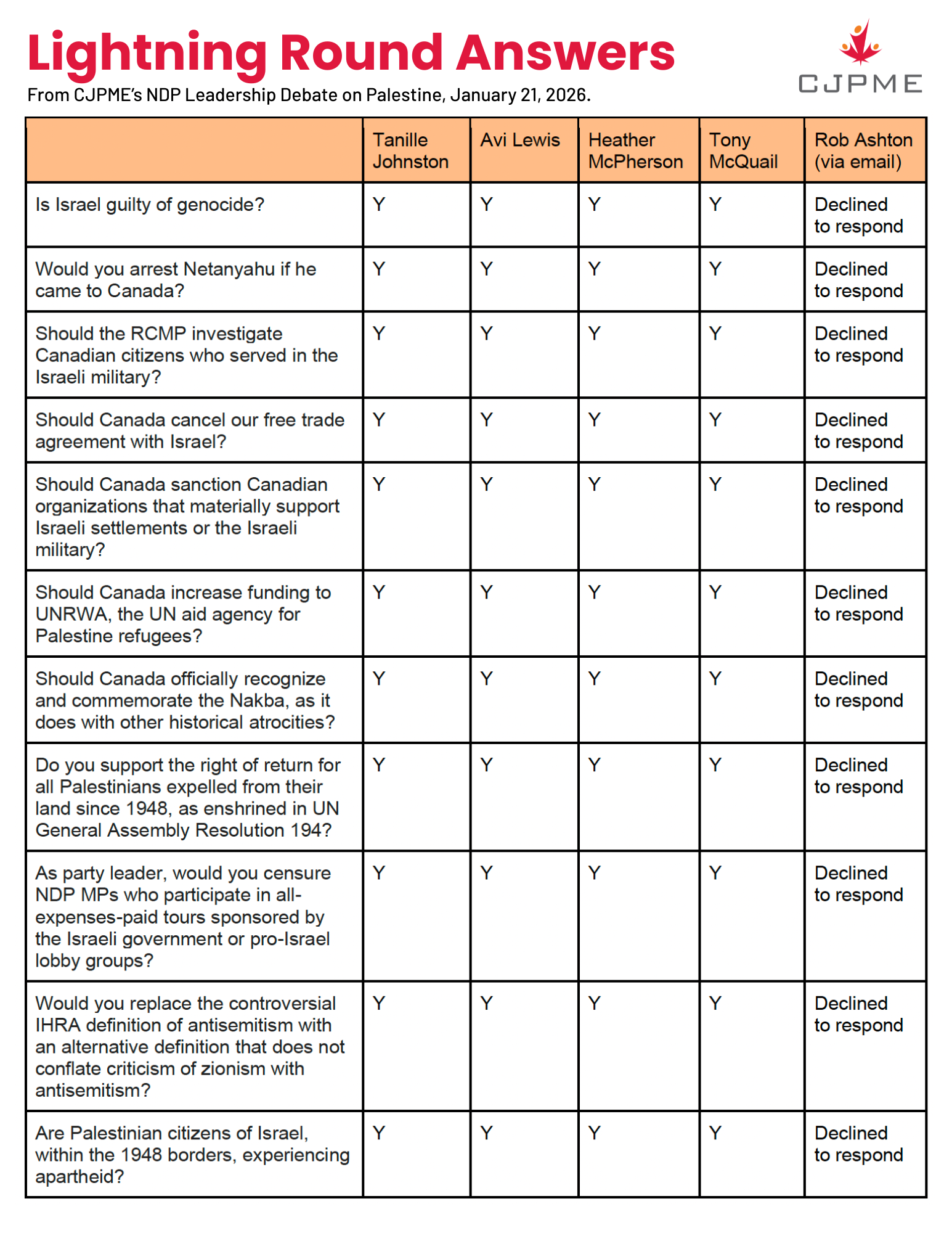
CJPME notes that the NDP has significantly shifted on the issue of Palestine over the past decade, making major progress since the last leadership race in 2017. At that time, most candidates were reluctant to speak about the issue and rarely put forward substantive policy ideas that reflected movement demands. Today, however, support for Palestinian rights has increasingly become mainstream within the party, and every single candidate has spoken out against Israel’s genocide in Gaza.
That does not mean that there are no differences between the NDP leadership candidates in this race. Even if they are more closely aligned than ever before, only two of the candidates – Avi Lewis and Heather McPherson – are known to have a track record on this issue outside of the campaign. CJPME urges NDP members to consider which candidates they believe will lead on this issue.
Of particular importance to the below assessment were the candidates’ responses during CJPME’s NDP Leadership Debate on Palestine, which was held virtually on January 21, 2026. A video of the debate is available on CJPME’s YouTube channel. Every candidate participated in the debate except for Rob Ashton, who cited scheduling issues. Ashton provided written responses to the long-form questions following the debate, but he declined to respond to the lightning round questions.
In evaluating the candidates, CJPME has decided to forgo a definitive grading system and instead place each candidate into 1 of 3 tiers. This is due to the large degree of consensus held between most of the candidates, and the difficulty involved in making a precise ranking based on their diverse experiences, statements and actions. The tiers are distinguished as follows:
- Tier 1 includes top-level candidates who strongly support the demands of the Palestine solidarity movement and have a solid track record on this issue, either inside or outside Parliament.
- Tier 2 includes candidates who have demonstrated strong support for Palestinian human rights, but who have not been as active on this issue.
- Tier 3 includes candidates who have not provided sufficient information to adequately evaluate their positions or expressed views that fall short of the demands of the Palestine solidarity movement.
Note that candidates within the same tier are listed below in alphabetical order by last name, and this does not imply a preferred ranking order for the NDP ballot.
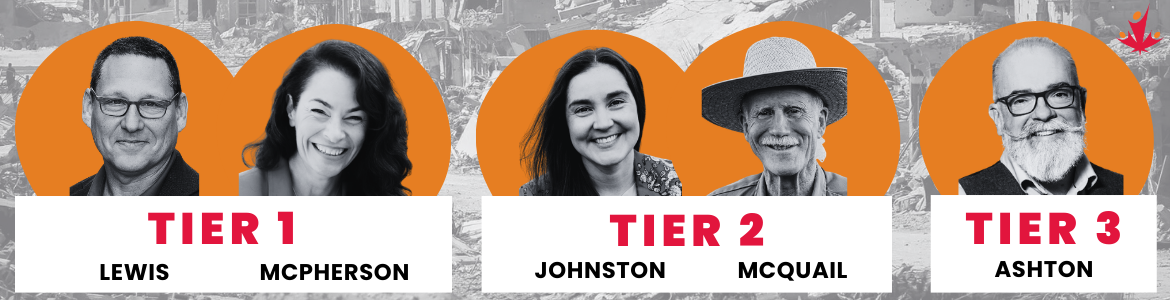
Tier 1: Avi Lewis and Heather McPherson
Avi Lewis and Heather McPherson are both in Tier 1 due to their strong policy positions combined with a significant previous record on this issue.
- As a journalist and activist, Lewis is a long-time supporter of the Palestinian-led boycott, divestment, and sanctions movement and has spoken out against the weaponization of antisemitism to silence advocacy on Palestine. He is more connected to grassroots social movements and articulates a vision motivated by Palestinian liberation and anti-imperialism. However, he doesn’t have any governing record or Parliamentary experience to evaluate his positions against.
- As NDP foreign affairs critic, McPherson has dramatically moved the party to become a more outspoken and principled advocate for Palestinian human rights, and has frequently brought the demands of the solidarity movement into Parliament. Her extensive experience is grounded in a commitment to the universal application of international law. However, her decisions in Parliament have not always reflected the will of the grassroots.
Tier 2: Tanille Johnston and Tony McQuail
Tanille Johnston and Tony McQuail have each spoken forcibly against the genocide and have indicated their strong support for the demands of the Palestine solidarity movement, but their answers demonstrate less familiarity with the issue than some other candidates. CJPME is not aware of either candidate having a significant track record on this issue outside of this campaign, although there may be statements we could not find. Notably, each candidate contributes to this issue from a different perspective:
- As an Indigenous person, city councillor, and social worker, Johnston emphasizes the connections between colonialism in both Palestine and Turtle Island.
- As an organic farmer, environmentalist, and war resister, McQuail speaks out on Palestine from the Quaker tradition and peace movement.
Tier 3: Rob Ashton
As the President of a labour union, Rob Ashton has rightfully spoken against Israel’s genocide and speaks strongly about universal human rights from the perspective of the labour movement. However, Ashon is placed in Tier 3 due to a lack of clarity on his policy positions and his failure to endorse movement demands. His answers are notably weaker than other candidates, and he declined to respond to CJPME’s lightning round questions. As a result, we do not know where he stands on a wide range of policy issues, from a two-way arms embargo to the Canada-Israel Free Trade Agreement. This falls far short of what the Palestinian solidarity movement is asking for, and poses a risk that he may pull the NDP backwards on this issue.
***
CJPME is a non-partisan organization. We do not endorse or back any specific political party. We recognize that CJPME members and supporters support different political parties at any given moment. We have previously assessed the candidates for the Liberal, NDP and Green parties in recent leadership contests. We provide these resources so that Canadian voters can be better informed of the candidates’ records and positions on Palestinian human rights.
Click here to download the full guide and analysis